Why use Pre-filtration

Prevent blockages
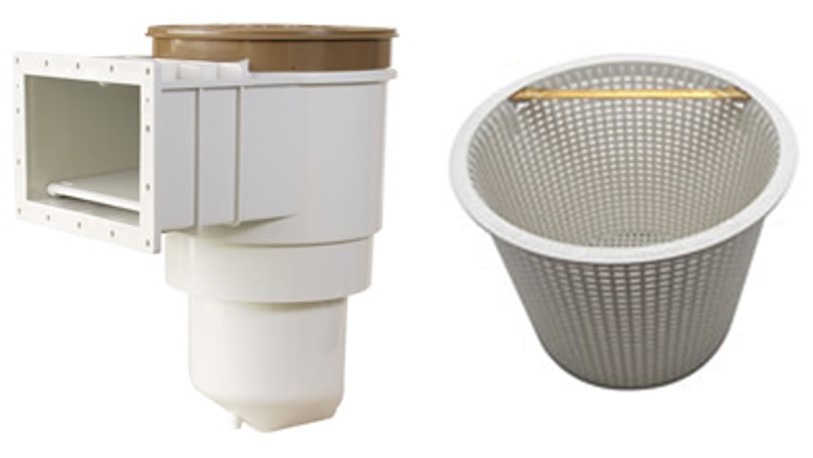
If a skimmer basket wasn't used, there is a high risk of blocking pipes and other equipment.
This first method of pre-filtration is generally accepted as a 'must' when constructing a swimming pool, yet no further thought is given to pre-filtration.
Improve circulation
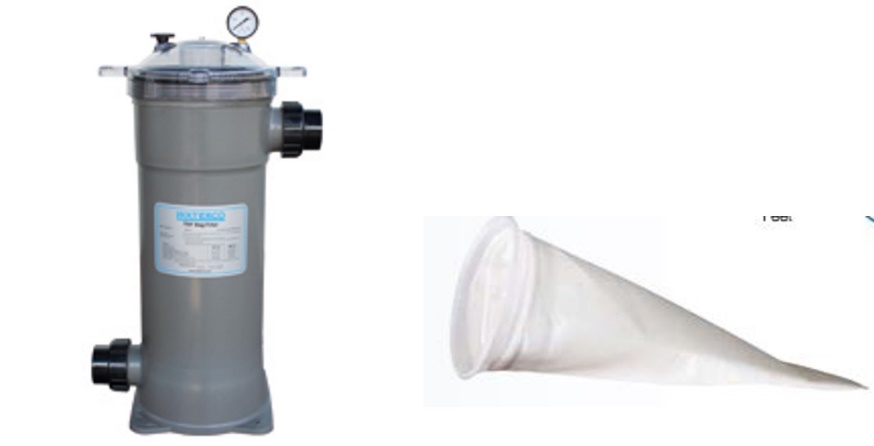
Leaf trappers (bag filters) have a large capacity and can collect a lot of coarse debris before it reaches the pump.
This helps the pump circulate more water without becoming blocked itself.
Improve water quality
Using a combination of pre-filtration methods, much of the coarse debris can be removed before the primary filter.
This allows the primary filter to perform more efficiently, improving water quality.
Service/cleaning cycles are extended, which can also save water.
Waterco's award-winning MultiCyclone is an example of how pre-filtration can be most effectively used to improve water quality and save water.
Extend equipment life
If pre-filtration devices are installed, the life of equipment such as pumps and filters can be extended.
Effective pre-filtration will also prevent damage to other equipment, such as pool heaters and salt chlorinators.
Save $$$
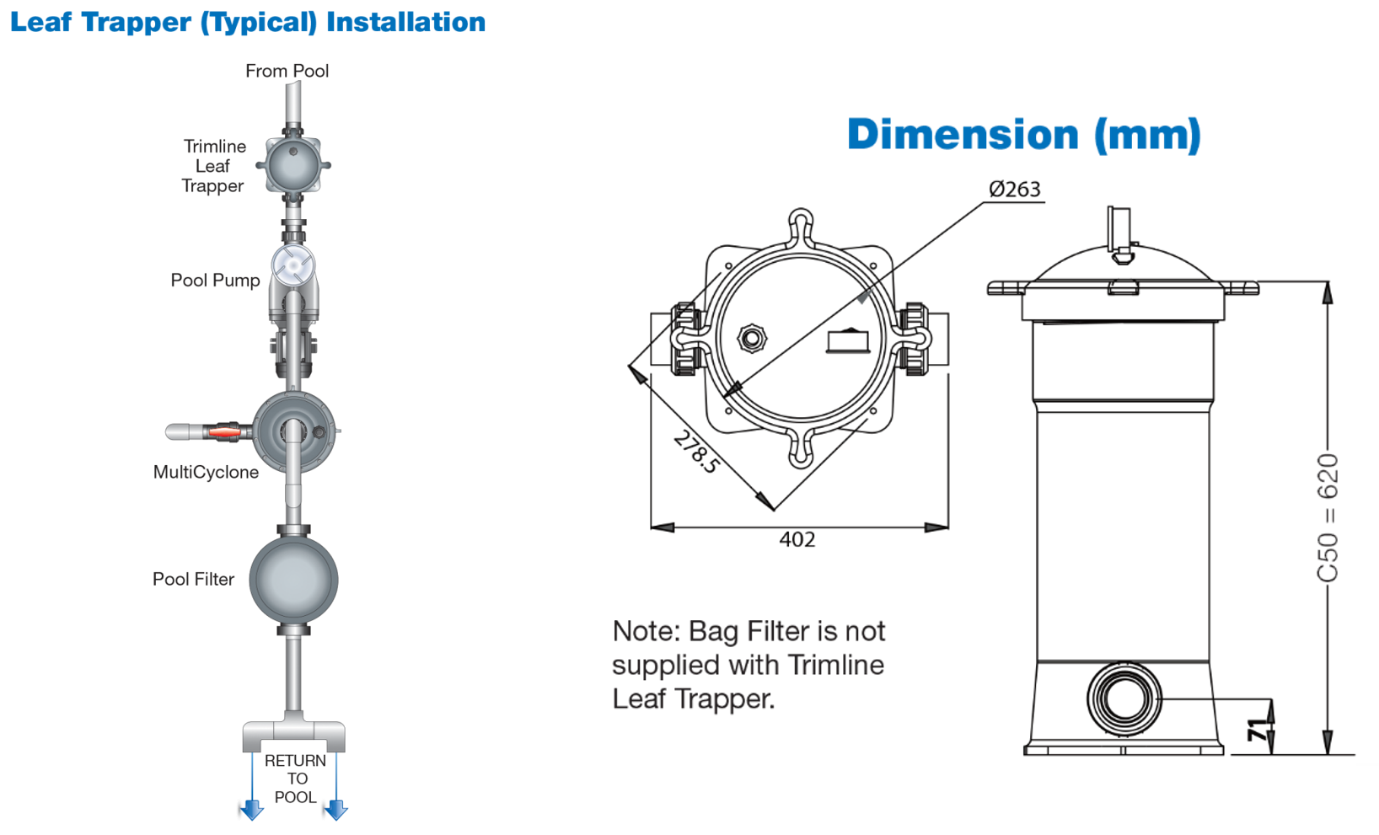
The Trimline Leaf Trapper (3761053) is for areas of high leaf and debris collection prior to a pool’s finer filtration system. Filter bags from 1 micron to 800 microns are available; 800 micron bags are used in an Infloor application.
Removing leaf debris, hair, lint and organic matter before the filter will;
- reduce sanitiser consumption, and
- extend media life
Primary markets
- In Floor Cleaning Systems
- Spill-over tanks
- Pools with high bather load;
- learn to swim
- unit complexes
- children's pools
- Negative edge pools
- reduce the load on the pool pump
- Pre-filtration equipment;
- water features/fountains
- cooling towers
- water treatment
MultiCyclone is a brilliant new pre-filtration device that can help you save thousands of litres of water and reduce filter maintenance.
Based on the principles of centrifugal water filtration, MultiCyclone collects 80% of the dirt that clogs your filter before it reaches the filter.
It drastically reduces backwashing and filter cartridge maintenance. There are no moving parts to wear and tear, and no filter media to clean or replace.
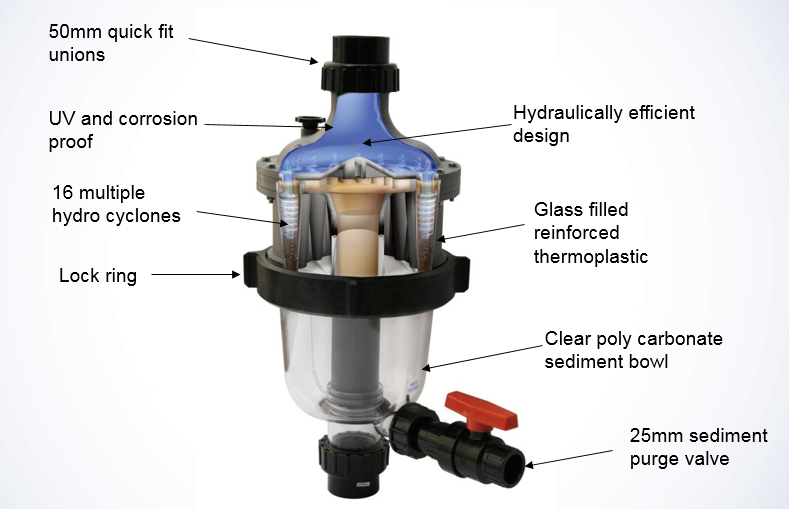
Features and Benefits
Save water
An average sand filter may require approximately 4,000 to 8,000 litres of water a year to maintain it.
Sand filters require an occasional backwash and rinse [on average] every month to 2 months, depending on the pool's dirt load and the filter's size.
Each backwash and rinse equate to an average of approximately 700 litres.
If you backwash [on average] every month, your pool filter requires approximately 8400 litres of water a year.
Minimise backwashing
The MultiCyclone intercepts 80% of the dirt load.
Only 20% of the dirt load reaches the filter. Backwash frequency is reduced by 1/5th.
Ease filters workload:
- Improving pool water circulation
- Enhancing the performance of the automatic pool cleaner and in-floor cleaning system
- Allowing effective pool vacuuming without burdening the pool filter
- Minimizing filter maintenance and saving water
Minimise cartridge cleaning and replacement:
Installing a MultiCyclone as a pre-filter to a cartridge filter can reduce filter cartridge cleaning and replacement to once per swimming season and even up to once per year, depending on the cartridge filter size.
Centrifugal water filtration:
The MultiCyclone works based on centrifugal water filtration.
- No moving parts to wear and tear
- No filter media to clean or replace
Ease of maintenance:
- MultiCyclone Plus’s sediment chamber is easily cleaned by opening its purge valve.
- Only 15 litres of water is discharged.
Effectiveness
- DE powder was passed through the Multi Cyclone to discover its effective flow rate.
- At 50 litres a minute, the MultiCyclone removed approximately 60% of DE powder, and at 350 litres a minute, it removed 80% of DE powder.
Range
MultiCyclone 12 – 200371 MultiCyclone 16 - 200370
- The main difference between the two Multicyclone is the number of hydro cyclones, 12 versus 16 and the connection ports of 40mm versus 50mm
- The MultiCyclone 12 is only equipped with 12 hydro cyclones so that it can perform better at lower flow rates
- At higher flow rates, the head loss of the MultiCyclone unit becomes prohibitive
The main effect of the MultiCyclone 12’s, 12 hydro cyclones verses. MultiCyclone 16’s, 16 hydro cyclones are its effect on its head loss characteristics;
- At 225 lpm, the head loss;
- MultiCyclone 12 is approximately 3.5M
- MultiCyclone 16 is approximately 2.8M
Typical Installation
- Position the filter as close to the Swimming Pool / Spa as possible.
- Position the filter so that it is free from flooding, away from sumps, guttering, garden hollows, etc.
- Position the filter so that the piping connections purge valve and air release valve are convenient and accessible for operation, servicing and winterizing.
- Ensure that the compliance label is facing the front to allow easy identification.
- The filter should be placed on a level concrete slab, very firm ground, or equivalent. Ensure that the ground will not subside, preventing any strain from the attached plumbing.
- Ensure that there is no movement of the filter during the operation of the Purge valve.
- Allow sufficient clearance around the filter to inspect the entire system visually.
START-UP PROCEDURE
To start up, the filtration system, either from new or after cleaning, is precisely the same.
- Ensure that the MultiCyclone is plumbed correctly.
- Ensure that all valves installed before and after the MultiCyclone are open.
- Loosen the air release valve on top of the MultiCyclone filter
- Prime the swimming pool pump
- Turn on the swimming pool pump and allow the pump to run until all the air has been expelled from the MultiCyclone. Water will run from the air release valve.
- Re-tighten the air release valve
- The filter is primed and ready for operation
Warranty
MultiCyclone is covered by a 2-year warranty and a 1-year labour warranty.
A 1-year warranty covers commercial installations.
Please sign in to leave a comment.
Comments
0 comments